Offices of the future. Trends transforming the office market in Poland
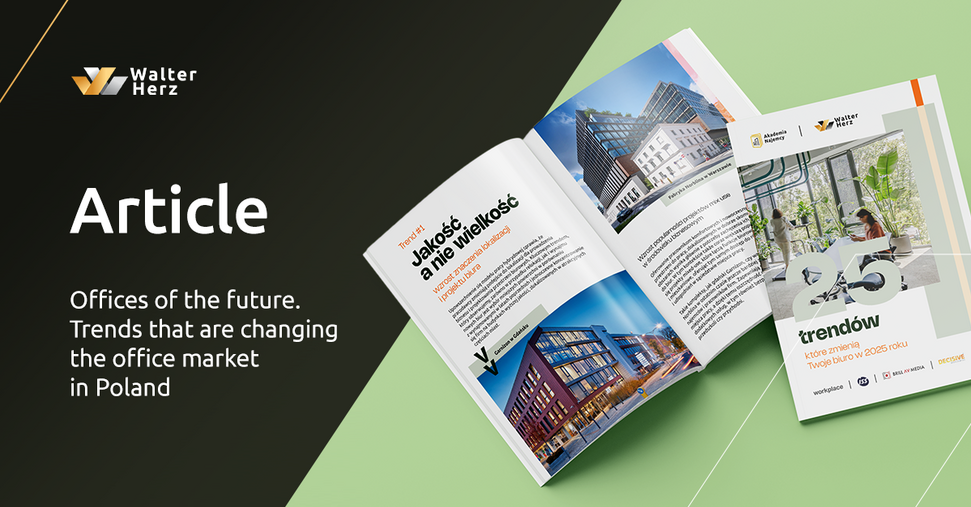
Global economic and financial transformations impact the way companies and workplaces operate, increasing the importance of convenient and attractive offices that provide a user-friendly environment and efficient technological solutions. A report prepared by the consulting firm Walter Herz describes the leading trends shaping the future of the office market in Poland.
The report titled ‘25 Trends That Will Transform Your Office by 2025,’ developed by Walter Herz in collaboration with experts from Workplace, ISS Polska, DECISIVE Szmigiel, Papros, Gregorczyk, and Brill AV Media, highlights the main factors driving changes in the office sector. These changes are connected to new workspace design concepts, the use of modern office technologies, efficient space management, and new legal provisions protecting tenants. The foundation of the report is a thorough market analysis, current research results, and insights gathered from numerous projects undertaken by companies.
-The analysis outlines the trends we are observing in the office market in Poland that will have the greatest impact on its future. It discusses the shift brought about by the winds of change in the sector. The knowledge included in the report can inspire the creation of efficient and cost-optimized office spaces that respond to the new work systems and employee expectations. The report includes information on innovations in office design and management, technological solutions entering workplaces, and new provisions in lease agreements that protect tenants in the event of unforeseen changes - says Mateusz Strzelecki, Partner/Head of Tenant Representation at Walter Herz.
Office market
Among the key trends shaping today's office market, Jarosław Zdzitowiecki, Head of the Walter Herz branch in Tricity, lists: # Quality over size of office spaces, # Office as a social hub, # Limited supply of new office investments, # Rising fit-out and service charge costs, and # Subleasing.
-The widespread adoption of hybrid work is driving the trend for tenants to choose smaller office spaces compared to previous years, both when relocating and leasing new offices. Companies are focusing on high-quality buildings located in attractive, central urban areas. Offices do not need to be large, but they must be comfortable and situated in accessible locations to encourage a return to on-site work. In this context, mixed-use projects that combine office, retail, and residential functions, offering access to a range of services and amenities, are gaining popularity - says Jarosław Zdzitowiecki.
Offices are becoming primarily meeting places for building relationships, team spirit, and company culture. Through appropriate design, these spaces foster team integration. Employers, often involving employees in the design process, are consciously creating a welcoming work environment where people are eager to come, work, participate in company life, and relax in designated leisure and fitness zones.
A characteristic phenomenon in the office market is the low supply of new space, which means that it is increasingly difficult to find an attractive address that appeals to employees. High construction and financing costs, coupled with reduced demand for office space, are causing developers to halt new projects. The limited number of new investments leads to demand for prime office space in city centers outstripping supply, which may result in higher rental rates.
A major challenge for market participants is the rising cost of fit-outs and service charges. Companies require transparent offers that closely align with their budget plans. There is also a growing trend toward reducing costs associated with outfitting and designing new offices, resulting in an increased share of lease renegotiations.
Tenants are also increasingly seeking ways to optimize and control operating expenses related to office maintenance. The optimization of space occupied by companies, along with workforce adjustments in some industries, is driving a rise in sublease options, which are economically competitive compared to standard leasing.
Design
The design and functional profile of office spaces are also undergoing significant changes. Key trends related to designing space are outlined in the report ‘25 Trends That Will Transform Your Office by 2025’ by Bogusz Parzyszek, CEO and founder of Workplace, a market leader in designing future-ready work environments and one of the most awarded companies for innovative solutions and creating exceptional offices.
-The leading trend in office design is linked to the need to build company culture and consciously shape the social and organizational aspects of the work environment. The designed space should effectively foster the employee community by creating suitable conditions that promote integration and collaboration - explains Bogusz Parzyszek. - Inclusive office spaces should cater to the diverse needs of the team, offering zones tailored to different work styles. The office environment should enhance employee well-being and create more opportunities for interaction - he adds.
Experimentation is becoming the foundation of design processes, focusing on adapting workplaces to the changing business environment as well as the specific requirements and goals of individual organizations. One direction is the implementation of neuroscience guidelines in interior design, aimed at promoting mental and physical regeneration through design and amenities, while also supporting employee well-being. Increasing emphasis is placed on eco-friendly materials and technologies, including those that improve air quality and the health of office users. Flexible, easily modifiable solutions are being introduced into office interiors.
A shift in narrative and approach is guiding designers. Workplaces are being tailored to the needs of people who regularly use the offices, moving away from trying to attract all employees. Universal solutions are being replaced by those that meet the needs of specific groups, leading to the creation of dedicated zones for different teams or types of work.
ESG principles and sustainability dominate office design. This results in smaller, but more efficient and energy-saving spaces.
-Advanced technologies based on data analytics and computational models are being used to optimize office spaces and improve their operational efficiency. Smart workplace management, such as using reservation systems that track actual space usage, increases efficiency and reduces resource waste. Integrating sensors and IoT devices in office spaces brings both work comfort and savings. This enables automatic control of HVAC (heating, ventilation, and air conditioning) systems and lighting. Advanced analytics platforms, meanwhile, allow data processing and analysis, enabling the creation of predictive models that are useful in office space planning, such as optimizing the placement of desks, meeting rooms, and relaxation areas, ultimately creating more efficient and employee-friendly workplaces - says Bogusz Parzyszek.
Productive innovation is a trend based on the belief that a well-designed space should foster a state of mind known as productively-innovative. To achieve this, office design must incorporate elements like building a sense of belonging within the organization, creating spaces for deep focus, collaboration, and leisure zones.
Fit-out and Build
The indicators of modern fit-out are outlined in the report by Alicja Muszalska, an architect on the Capital Projects team at ISS, a leader in Facility Management, creating employee-friendly workplaces, and providing comprehensive facility management. Alicja Muszalska identifies #Durability, #Moderation, and #Utility as the foundation of modern office fit-out. Among the most visible trends are also #BoutiqueOffices and #ParadoxManagement.
Durability here means designing spaces with long-term leases in mind, using high-quality, durable materials and recycled elements, with a strong focus on environmental care and ESG principles.
Moderation refers to creating cost- and environmentally efficient spaces, both during construction and operation. This includes reusing and modifying existing furniture when relocating offices, recycling materials, and implementing solutions that reduce media consumption and use BMS and IoT systems. It also involves designing mixed-use, boutique offices equipped with high-quality AV equipment, following the principle of ‘less, but better.’
Utility addresses social issues, which are crucial for the younger generation, such as diversity and inclusivity. DEI (Diversity, Equity, and Inclusion) policies guide the design of workplaces to promote building social bonds within diverse groups and the entire team.
Paradox Management seeks to balance conflicting interests in managing the user experience in offices, particularly when social aspects conflict with environmental concerns. An example is providing different types of milk, which can lead to waste.
Technology
Technology is key in office planning. Cezary Gromko, AV Integrations Account Manager at Brill AV Media, which advises and implements professional audiovisual solutions for business spaces and public buildings, discusses the most advanced solutions in offices in the report. Brill AV Media offers comprehensive services in permanent audiovisual installations, including video conferencing systems, digital signage, professional monitors and projectors, sound systems, as well as space reservation and control solutions.
One of the fastest-growing trends, according to Cezary Gromko, is the integration of podcast studios in office spaces. -Companies are recognizing the great benefits of solutions that go beyond traditional AV technology. Podcast studios significantly enhance internal communication and serve as an attractive benefit for employees. Externally streamed podcasts can be used as part of a company's content marketing strategy – says Cezary Gromko
Another innovation being introduced in offices is interactive monitors, which significantly boost creativity during project work. They allow for real-time visualization of ideas and collaboration on documents, presentations, and graphics. Cloud integration enables easy sharing and saving of work results.
USB-C technology allows office laptops, monitors, power supplies, and even peripherals to be connected with a single cable, keeping workspaces clutter-free. A single USB-C connection can handle data transfer, power supply, and video and audio transmission.
The development of LED technology and the miniaturization of devices means that modern AV solutions in offices are not only more efficient, but also more discreet and aesthetically pleasing. The trend toward downsizing devices like projectors, speakers, and cameras makes it easier to integrate them into office furniture without disrupting the interior's style.
Interactive spaces in relaxation zones are another trend in creating innovative workplaces. Advanced technologies like interactive floors, walls, or tables allow employees to engage in various creative forms of entertainment and education.
Legal Provisions in Lease Agreements
Andrzej Szmigiel, Partner at DECISIVE Szmigiel, Papros, Gregorczyk, which specializes in real estate, construction, and litigation, discusses new provisions in office lease agreements in the report. These include force majeure clauses in the context of the conflict in Ukraine, anti-Russian clauses, green clauses, and provisions related to energy cost management and securing service levels from landlords.
A new trend in lease agreements is the inclusion of Service Level Agreement (SLA) clauses that secure the level of services provided by landlords. Just a few years ago, it was unthinkable for institutional landlords to agree to provisions concerning the appropriate level of services in buildings, including the removal of defects and faults in the leased space. Now, such clauses are becoming increasingly common. Lease agreements also increasingly require landlords to maintain relevant certifications for buildings, implement energy-efficient solutions, use green energy, and follow trends in reducing energy and water consumption, waste management, and minimizing environmental impact.
The drastic increase in electricity prices has made energy consumption one of the most important cost factors in lease agreements. More and more tenants are striving to introduce clauses that allow them to negotiate individual energy supply contracts and ensure technical capabilities for energy self-sufficiency. Recent experiences, such as the pandemic and the war in Ukraine, have made it more important in long-term leases—particularly those involving significant investments and fit-out work, or contracts signed at the construction stage—to carefully define and account for force majeure scenarios, considering potential global developments.
Due to escalating armed conflicts and aggressive actions by authoritarian regimes, both the U.S. government and the European Union have introduced numerous sanctions limiting cooperation with entities from certain countries or those closely linked to them. Many international institutions are obliged to ensure that their operations have no connections with entities subject to sanctions. As a result, clauses addressing these issues are becoming more common in contracts.