How art helps build organizational culture
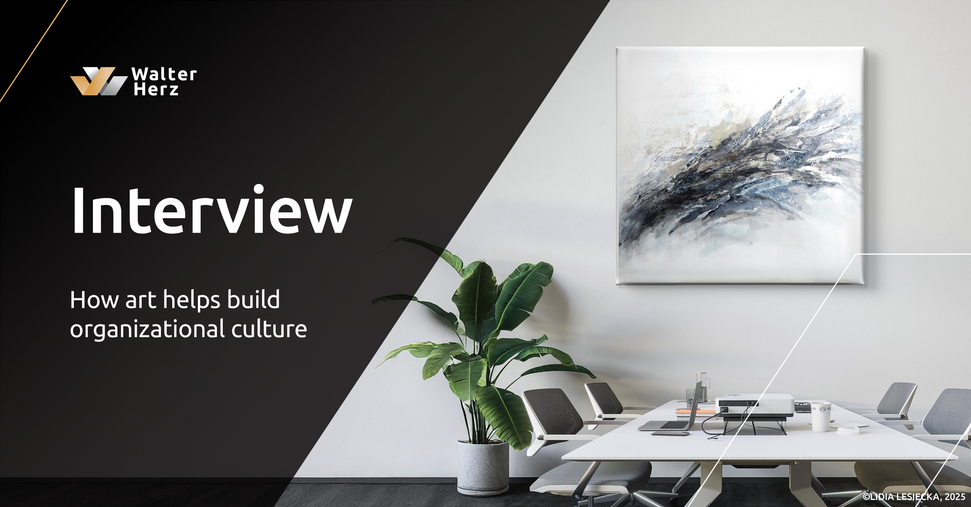
A conversation between Magdalena Zagrodnik (Partner, Board Member at Walter Herz) and artist Lidia Lesiecka.
Art is appearing more and more often in workplace strategies and in HR discussions about well-being. During the Kraków edition of the Walter Herz Akademia Najemcy (The Tenant Academy) “The power of change. People, the office and AI in the new reality”, Lidia Lesiecka’s paintings were an integral part of the event space, the backdrop for conversations about the future of work and, at the same time, the starting point for very practical questions: what does art bring to an office, how does it affect the team, and how can it help brands?
Magdalena Zagrodnik: From the feedback we received after the Akademia Najemcy in Kraków, it’s clear that people really noticed the art. How do you see an event like this: a conference about AI, among other things, and right next to it – your paintings?
Lidia Lesiecka: For me it’s a completely natural combination. We’re talking about change, about the new reality of work, about technology, but everything always happens in a specific physical space. What matters most is that the art isn’t just “decoration for the event”. It was part of the participants’ experience – the moment they entered the room they were greeted by a large, visually coherent exhibition. During the breaks many people came up, asked about specific paintings, and immediately moved on to talking about their own offices. One sentence kept coming up: “We have empty walls, it’s begging for something like this.” This shows a clear trend: offices and business events are no longer neutral backgrounds – they are becoming consciously designed environments, including visually.
What are the main directions today when it comes to art in offices? Do you see any particular tendencies in the projects you’ve been doing lately?
I see several very clear trends:
- Art as part of the concept
I’m increasingly invited at the office design stage, together with the architect. Not at the moment when they say “we have empty walls, we need to hang something”, but when they say “we’re designing zones – let’s think right away about the role art can play in them”. - Zone-specific art – different works for different functions
Different energy in the focus zone, different in the chill room, different in the creative rooms. Where concentration is needed – calmer compositions, muted palette. In meeting places – more dynamic, energetic works. - Rotating “mini galleries”
Companies are starting to treat the office as an exhibition space. Works are sometimes changed every few months. The team feels freshness, and the employer can, for example, promote local artists. - Stronger connection with the brand
It’s not about hanging logos – it’s about coherence of values. If a company talks about innovation, courage, local roots, well-chosen art can visually “translate” those values.
This is a real shift from “pretty pictures” to a tool that supports workplace strategy.
How does this actually translate to the team? From the HR and administration side we most often hear the question: “What does it really change for people?”
A well-designed visual space supports team efficiency. The brain needs natural “rest points” – instead of staring at a screen non-stop, the eye can pause for a moment on a painting. These are small, often imperceptible micro-breaks that affect the perceived level of tension and fatigue. Second – how people use the office. I see it in projects: when coherent art appears in common areas, people are much more willing to use them. The kitchen, reception, corridors become real places of integration rather than just transit zones. Third – identification with the place. When the team has influence on what hangs on the walls (through workshops, voting, choosing works), the sense grows that “this is our office”, not just some randomly rented space. From an HR perspective these are very concrete arguments: art supports well-being, integration, retention – because people simply enjoy returning to a place that feels made for them.
From the brand and client relations perspective it’s also noticeable. At Walter Herz we often hear: “You have a great office, it says a lot about the company.” I could tell you about one of our projects, and maybe you can comment on what “worked” here. As part of a team-integration initiative we organised painting workshops, but in teams made up of people who don’t normally work together. Advisors, marketing, administration, different departments – all together at one canvas. Those works now hang on the walls of our office. And very often a client meeting starts with the question: “Who painted this?”, “Is it a local artist?”, “Why these particular colours?” The conversation about the market or transactions begins on a very human level, from the story of our team. The distance disappears in a few minutes.
This is a brilliant example where several layers come together at once: internal integration – people from different departments create something together on one canvas; identity – the result stays in the office and is visible every day to everyone; client first impression – from the moment they walk in they see this isn’t a “generic” office, but a place with its own history. From the brand perspective, such paintings act as a natural “conversation opener” – they build an atmosphere of collaboration and show organisational culture without slides or official declarations.
Let’s get concrete. What, in your opinion, should an administration director or HR person who, after this conversation, thinks “I want to take the first step towards art in our office” start with?
I would start with three simple steps.
- Space audit
First, walk calmly through the office – as a user, not as someone responsible for square metres and budgets. See where people most like to sit, where it’s empty, which places “drag down” – feel cold, random, characterless. - Define the goals
Then answer a few questions:- in which zones do we need more calm, and in which more energy?
- what is the priority today: better team integration, a stronger “wow” effect for clients, or primarily improving everyday comfort?
- Choose the right formula
Only against this background do we select a solution that fits the budget and goals. It can be:- purchase of works (individual or whole cycles) tailored to specific zones,
- a rotating “mini gallery” created in cooperation with an artist,
- workshops and creating works together with the team, exactly as you did at Walter Herz.
At this stage it really helps to involve an interior architect and an artist. This is how a coherent concept is created, not a collection of random “pretty pictures” on the walls.
Finally – one sentence for decision-makers who look at the office very business-like: cost tables, ROI, KPIs. What would you tell them?
That art in the office is not an expense “on pretty walls”, but an investment in the employee and client experience. And that translates directly into retention, recruitment effectiveness and the way the company is remembered in a competitive market. If the office is to support the business strategy, it’s worth making sure the walls “work” too – not just the square metres and equipment.
Lidia Lesiecka is a visual artist based in Kraków, creating expressive abstract paintings and impressionistic landscapes. She graduated from the Institute of Art at the Pedagogical University in Kraków with a degree in printmaking under Professor Andrzej Bębenek. A member of the Association of Polish Artists and Designers (ZPAP), she has held dozens of solo and group exhibitions, and her works are part of private collections in Poland and worldwide.