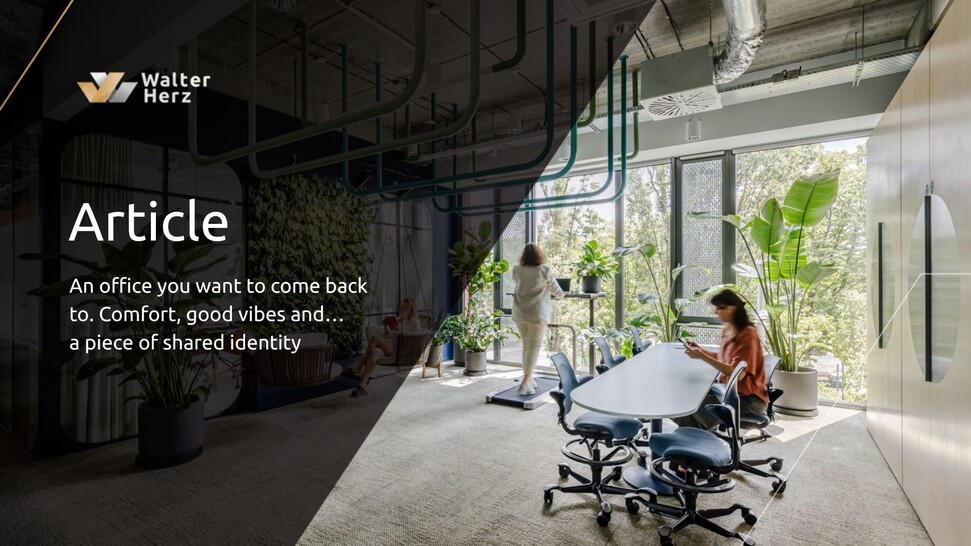
An office you want to come back to. Comfort, good vibes and… a piece of shared identity
Finding ways to attract and retain employees in the office has become one of the most widely discussed topics in the era of hybrid work. The key question is: how do you create a space employees want to return to – not out of obligation, but out of the need for collaboration, connection, and a sense of purpose?
An office designed for the realities of 2025 should offer much more than comfortable desks and modern equipment. It needs to create an atmosphere that fosters relationships and strengthens team bonds. These insights come not only from observing workplace trends but, above all, from conversations with participants of this year’s Tenant Academy events organized by Walter Herz.
These conferences focused on wellbeing, female leadership, and the future of office work. Dedicated primarily to women working in administrative and HR roles, the events highlighted that the modern office is not just a physical space – it’s an essential element of organizational culture, one that significantly impacts employee engagement and overall wellbeing.
This demonstrates a simple truth: the strength of an organization is built by its people – and women often play a pivotal role in shaping that strength. They are the ones driving change, caring for teams, and focusing on details that directly influence comfort, productivity, and efficiency. Their contribution to shaping workplace culture is invaluable, and the modern office can – and should – be the space where this influence is allowed to flourish.
Relationships, leadership and a shared purpose
Beyond providing the right space for professional growth, what matters most today are relationships, quality collaboration, and a positive atmosphere at work. Employees are drawn back to offices where they feel supported and connected to a shared goal.
Talented people are best attracted and retained by investing in their growth and creating an environment where they can thrive. Flexibility, transparency, and responsible leadership have become decisive. Leaders – and increasingly female leaders – who can build a strong sense of identity and align teams around a clear vision, create spaces employees want to be part of. They design workplaces where people come not because they have to but because they want to.
Wellbeing in the office is more than design
The way employees feel in the workplace is becoming just as important as its aesthetics. Office design is no longer only about visual appeal – it’s about functionality, flexibility, and support for wellbeing.
We now see the rise of project-based collaboration zones, ad hoc coworking areas, quiet rooms for focused work, bookable private spaces, and wellbeing rooms designed for relaxation and recovery. Offices are evolving from static workplaces into spaces that support balance and authenticity.
It’s also important to note that office transitions and relocations – often stressful and complex processes – are frequently led by women: office managers, HR leaders, and administrative directors. They oversee employee comfort, safety, and wellbeing throughout the transformation. Their organizational skills, empathy, and attentiveness are becoming critical assets in shaping the offices of the future.
That’s why the March edition of Tenant Academy, titled “Office Relocation Without Stress”, was designed with these professionals in mind. It became not only a platform for sharing knowledge but also a moment to pause, reflect, and care for oneself. The event highlighted the importance of resilience, mindfulness, and self-care – particularly for those managing constant change and high-pressure environments.
Functionality, time-saving and the value of location
Caring for employees goes beyond an appealing office interior. Increasingly, everyday conveniences influence workplace satisfaction. The ability to save time thanks to nearby services, dining options, and amenities has become one of the most valued benefits.
It’s no surprise, then, that mixed-use office complexes are gaining popularity, seamlessly integrating workplaces with lifestyle spaces. While a prestigious address still matters, accessibility and commuting time are becoming decisive factors.
In today’s fast-paced world, an office located near transport hubs, metro stations, and key city connections isn’t just a convenience – it’s a strategic advantage in attracting and retaining talent.
Technology that supports, not replaces, people
With the growing need to optimize time and boost efficiency, technology – especially AI-powered solutions – is becoming an inseparable part of the modern workplace.
Can artificial intelligence make the office more human? Can technology help us connect instead of pulling us apart?
These were central themes of the Warsaw edition of Tenant Academy, titled “The Office in the Age of AI”. The event showed how AI-driven tools can automate repetitive tasks, freeing employees’ time and energy for building relationships, solving problems, and making meaningful decisions.
Participants had the opportunity to test generative AI in real scenarios – from writing effective prompts to managing complex information flows. Robot Pepper and its robotic “dog” became symbols of the future workplace – not as gimmicks but as metaphors for tools designed to support people, not replace them.
It all starts with people
No matter how much technology evolves or workplace models shift, the office will always be about people first.
A modern workplace is not an end in itself. Without relationships, empathy, and authentic values, even the most advanced space remains just an empty shell.
When designed thoughtfully and managed wisely, however, the office can truly foster growth, strengthen engagement, and create a shared sense of purpose.
Because the future of work – even in the era of AI – is, and always will be, written by people.
Author: Magdalena Zagrodnik, Co-Owner, Head of HR, Marketing & Public Relations, Walter Herz