Office assets back in investors’ focus
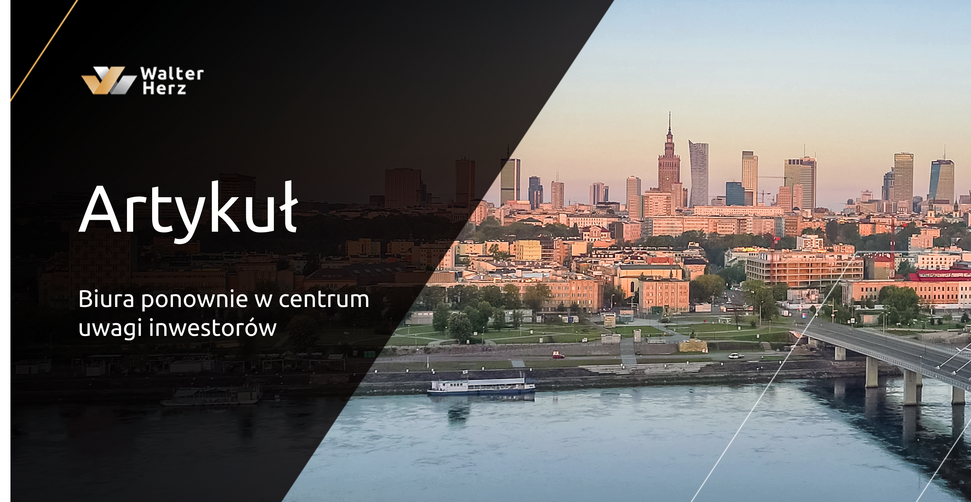
The office sector is strengthening its dominant position within the structure of investment transactions in Poland.
This is supported by the record-high demand for office space in the country’s largest office hubs, alongside a deepening shortage of new supply. The limited availability of modern space in prime locations is driving rental growth, improving asset profitability, and increasing investor interest in office real estate.
The increase in investment volume in Poland’s commercial real estate market is supported, among other factors, by a stable macroeconomic environment. The slowdown in inflation and the continuation of the interest rate cutting cycle are enhancing the availability and attractiveness of bank financing. At the same time, the country’s strong economic position and Poland’s advancement into the group of the world’s most industrialized economies are reinforcing the perception of the market as mature, stable, and scalable. Despite capital selectivity, Poland remains an attractive location for investors, and 2026 may bring an increase in investment activity based on solid fundamentals rather than a short-term trend – says Katarzyna Tencza, Transaction Director at Walter Herz.
Supply shortage
The most visible changes are taking place in the office sector in the capital market. In Warsaw, the process of reducing office stock is progressing. We are observing a trend involving the withdrawal of older, inefficient office buildings from the market. In 2025 alone, Warsaw’s office stock decreased by more than 160 thousand sq m in this way, and over the past five years, more than 500 thousand sq m of office space has disappeared from the Warsaw market. This phenomenon is structural in nature and has a significant impact on shaping the market offering profile, concentrating it around modern projects in prime locations.
At the same time, developer activity remains highly limited. Currently, only around 200 thousand sq m of office space is under construction in Warsaw and approximately 220 thousand sq m in regional markets, with the largest volumes in Poznan and Cracow. This is four times less than during the period of market prosperity. High demand combined with low supply is resulting in a systematic decline in vacancy rates across the country’s largest office markets, and in central areas of Warsaw, in a severe shortage of available space.
– A consequence of the current conditions in the office market is upward pressure on rents. Base rents for premium-class office space in Warsaw already exceed 30 EUR/sq m/month in select projects and show further growth potential. A similar trend can be observed in regional markets. Modest rent increases were also recorded last year in Cracow, Poznan, and Wroclaw. – says Monika Szymczyk, Senior Advisor at Walter Herz.
Increasing investment attractiveness of the sector
– Rising prime rents in the best locations directly translate into improved investment metrics for office assets. The highest demand is for buildings that offer an attractive price-to-quality ratio and the potential for further value growth through expansion and tenant mix optimization – says Katarzyna Tencza, Transaction Director at Walter Herz.
The office sector had already regained its position as the leader of the investment market in Poland in 2024, reaching nearly a 40 percent share of total transaction volume in 2025. This was made possible, among other factors, by the return of core transactions, reflecting a better alignment of sellers’ price expectations with market realities.
Domestic capital also plays a significant role in investments, accounting for approximately 30 percent of the investment volume in the office sector in 2025, with a focus on assets offering potential for value growth.
Demand hits records levels
In 2025, total leasing volume in Poland exceeded 1.56 million sqm, with renegotiations accounting for around half of that figure. Nearly 800 thousand sqm was leased in Warsaw, where the fourth quarter saw a record-breaking quarterly result of 310 thousand sqm of take-up. Amid a severe shortage of space in the city center, Słuzewiec returned to the spotlight, accounting for more than 20 percent of last year’s leasing volume.
Regional markets also achieved historic results. Both Cracow (270 thousand sqm) and Wroclaw recorded record-high annual demand. This rebound reflects companies’ return to more decisive space leasing decisions, while at the same time confirming the enduring role of the office as a place where businesses build their identity and potential, despite the ongoing transformation of working models.
Exclusive new supply
The scale of new supply remains limited. In 2025, only around 110 thousand sqm of new office space was delivered to the Polish market.
The highest volume of office development activity is concentrated in the capital city. New projects are being delivered mainly in central locations. Among the buildings currently under construction are the Skyliner II tower (130 meters) and Upper One (131.5 meters), while additional high-rise projects have already obtained building permits. However, at the current pace of development, a rapid rebalancing of supply and demand should not be expected.
Stable foundations for sector growth
The current market conditions – high demand for office space, limited supply, improving financing conditions and a stable macroeconomic environment – are creating a favorable setting for further growth in investment activity within the sector.
All indications suggest that 2026 may bring a stronger rebound, supported by solid structural fundamentals. Under this scenario, the office sector has a real opportunity to significantly strengthen its leading position in Poland’s commercial real estate investment market, attracting both domestic and international capital.