Flex market is accelerating
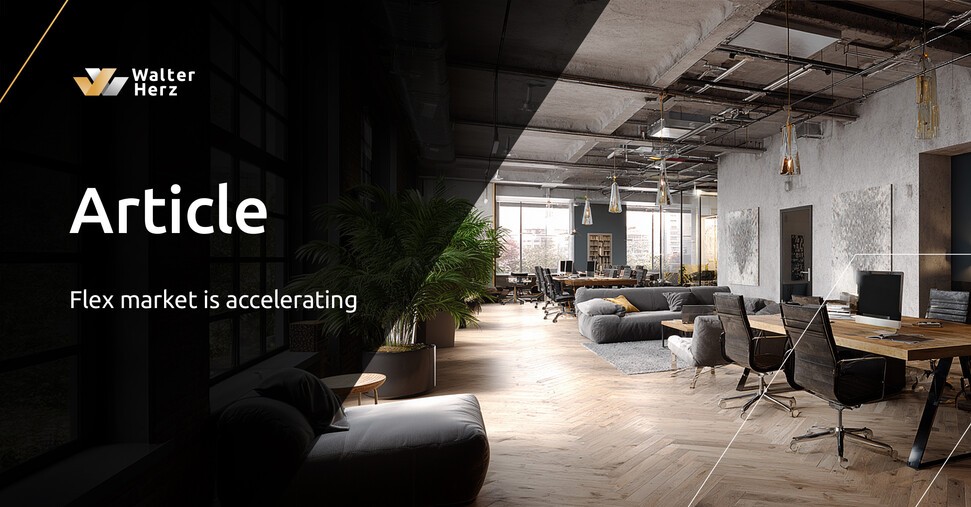
The flexible office market in Poland is growing dynamically. In the upcoming years, we can expect the pace of its development to accelerate.
Currently, over 420 thousand sq m. of flex space are available across the seven largest cities in Poland, accounting for more than 3 per cent of the country’s total office supply. In Warsaw and Cracow, flexible offices represent around 4 per cent of the market. Given the high costs of office fit-outs and the globally evolving work model, flexible offices are expected to significantly increase their presence in Poland in the near future, moving closer to the levels seen in other European markets.
Flex Market – A Trend Toward Diversity
The trends shaping the flexible office market in Poland are largely driven by the increasing polarization of lease formats being offered. Tenant propositions are becoming increasingly diverse and sophisticated. There's also a clearer shift toward viewing the office as a service (Backend-as-a-Service), rooted in full integration with advanced technologies, ESG principles, and community building.
A subscription-based office model is gaining ground in Poland’s flex market, allowing companies to access flexible office spaces in multiple locations across different cities under a single monthly fee. Among the available options, satellite offices are also becoming increasingly popular. These are office spaces arranged close to employees’ places of residence and serve as a complement to a company’s headquarters.
At the same time, flexible office spaces are being expanded within traditional office buildings, which is an effective way to utilize vacant areas and boost buildings’ attractiveness in the market.
Today, businesses treat flex spaces as a standard alternative to traditional offices—not as a temporary fix, but as a strategic choice replacing conventional office models. Some organizations are fully abandoning standard office setups and relocating entirely to flexible spaces, motivated by cost predictability, scalability, and faster time to operational readiness.
Warsaw and Cracow Lead the Market
Warsaw holds the largest share of Poland’s flexible office market, accounting for more than half of all flex space available in the country. The capital city offers approximately 235 thousand sq m. of space in this format. Outside of Warsaw, Cracow is the leading flex market, with nearly 70 thousand sq m. of flexible office space. Following closely are Wroclaw, the Tri-City, and Poznan. Interest in flexible spaces is also growing in Lodz and Katowice. Across Poland’s regional cities (excluding Warsaw), nearly 190 thousand sq m. of flexible office space is currently available—equivalent to around 23 thousand workstations.
In 2024 alone, flex office operators in the capital leased approximately 70 per cent more space than the previous year. Over the next few years, the sector is expected to expand even more rapidly. New flexible office spaces will be added to the market, particularly as part of upcoming developments in major regional cities.
Flex Spaces in Prime City Centers See Strongest Demand
The growing demand for flex spaces is driven primarily by the hybrid work model, which increases the need for leasing flexibility. Interest in flexible offices is rising especially in Warsaw and Cracow. Tenants are focusing mainly on central locations, particularly those with excellent public transport access—such as near metro stations. According to our observations, the most sought-after spaces are those for 3 to 15 people, typically ranging from 20 to 200 sq m. At the same time, demand is also increasing for larger modules, mostly used by project-based companies and foreign entities entering the Polish market.
The dominant tenants in Poland’s flexible office sector include companies from the IT and e-commerce industries, as well as marketing, finance, consulting firms, startups, and international corporations looking for satellite offices, temporary space, or flexible entry points into the market. In regional cities, demand is mainly driven by tech firms, service providers, and the SSC/BPO sector.
The flex market is becoming increasingly professional, with a more diversified demand structure. Its strong absorption capacity means that vacancy rates remain lower than in the traditional office market—at around 8–10 percent. Flex operators are also capitalizing on their ability to commercialize space in new developments more quickly than owners of conventional office buildings.
New Players
The growing popularity of flex spaces has led to the regular emergence of new local operators on the market, such as The Shire, BeIN, Puzzle, and boutique companies offering premium flex solutions. The increasing demand for flexible solutions in Poland is also motivating many developers to launch their own flex brands to provide additional, complementary offerings within existing office buildings.
Alongside global brands like Regus, WeWork, Mindspace, and Brain Embassy, local operators such as Chilliflex, Loftmill, and OmniOffice are also expanding their presence in Poland. Commercial building owners offer flexible offices under brands like Business Link, CitySpace, and Quickwork.
Today’s offerings include co-working spaces, serviced offices, project offices for fixed terms, and virtual offices. Operators provide increasingly diverse options in terms of location, quality, range of services, and flexibility of lease terms, making the market more competitive than ever.
Among the available options are premium-class spaces offered by providers such as Brain Embassy, The Nest, and Mindspace, featuring high-end design, wellness areas, cafés, event facilities, and concierge services.
Flexible Space Starting at Around 800 PLN per Month
Rental rates for flex offices in Poland vary depending on the city, location, and quality of the space. In central Warsaw, the monthly cost for a desk in a flexible space ranges from EUR 300 to 475. In regional markets, monthly fees per workstation typically range between EUR 200 and 375 s. These rates usually include all costs such as rent, utilities, cleaning, internet access, and common areas. In practice, billing is done via VAT invoices without signing traditional lease agreements, which are replaced by a simple declaration and payment for the given period.
Tenants expect short-term commitments—typically 1 to 3 months—scalability, transparency, and efficient service. Consequently, operators increasingly offer “pay-as-you-go” models, adapting their operational processes and procedures to a service-oriented approach. Tenants also look for flexible terms even for private offices accommodating 10 to 20 people.
Walter Herz supports companies in their search for flex spaces offered in various cities, both in private office and co-working models. We also advise flexible space operators on leasing office space from property owners. We have supported projects such as The Shire in Cracow and BeIN Offices in Poznan and are currently working on others in Wroclaw, the Tri-City area, and Cracow.
Mateusz Strzelecki, Partner / Head of Tenant Representation at Walter Herz
About Walter Herz
Walter Herz company is a leading Polish entity operating in the commercial real estate sector across the country. The company has provided comprehensive and strategic investment consulting services for tenants, investors, and real estate owners across the country since 2012. Walter Herz experts assist investors, property owners, and tenants. They provide full service to companies from the private and public sectors.
Walter Herz advisors support clients in finding and leasing space and provide consulting in implementing investment projects in the warehouse, office, retail, and hotel sectors.
The company is based in Warsaw and runs regional branches in Cracow and Tri-City. Walter Herz has created the Tenant Academy, the first project in Poland, which supports and educates commercial tenants from all over Poland by organizing specialized training meetings. The agency introduced the Code of Good Practice to ensure the highest ethical level of services.
In 2016, Walter Herz won the CIJ EUROPE award in the Rising Star of the Year category. It also won the title of the Best Local Agency of the Year 2022 in the CIJ AWARDS competition held in Poland. Subsequently, it achieved success at the regional level in Central and Eastern Europe during the 8th edition of the HOF Awards, earning the title of Best of the Best Local Real Estate Agency of the Year. In 2024, the company won the Best Local Real Estate Agency of the Year award for the second time.