


Articles providing insight on the commercial real estate market
Transactions, projects, trends and expert comments – brief and substantive info based on data and market experience.
Office market makes a comeback with a strong opening to 2026 and rising investor activity
23 April 2026The first quarter of 2026 brought a clear rebound in Poland’s commercial real estate market. Transaction volumes increased across all sectors, including the office segment. Demand for office space also remains strong, pointing to a gradual recovery in the market’s potential.
Positive signals are also emerging from the investment market this year. In Q1 2026, the value of commercial real estate investment in Poland exceeded €1 billion—over 40 percent higher year-on-year and the strongest result for this period in several years. Although the number of transactions declined, their total value increased (€635 million in Q1 2025).
In the office sector, transactions totaling €245 million were concluded (+40 percent year-on-year). They were carried out both in Warsaw and in regional markets, which accounted for the majority of acquisitions but only one quarter of the total transaction volume.
Recently, several prime transactions have been completed, including the purchase of Lixa D by a Swiss family fund and the acquisition of the Royal Wilanow complex for €100 million by the Czech fund Wood & Company from Capital Park Group. Brain Park A in Cracow was, in turn, purchased by the French company Arkea Real Estate.
For comparison, in Q1 2025 the value of office transactions amounted to €176 million (+60 percent year-on-year), with the largest deal being the acquisition of Wronia 31 by Uniqa Real Estate. At that time, value-add and opportunistic assets dominated.
– The value of investment transactions recorded this year indicates a market recovery. We expect this trend to continue, along with an increase in investment activity supported both by the growing involvement of domestic capital and the gradual return of core capital and prime transactions – says Bartłomiej Zagrodnik, Managing Partner and CEO at Walter Herz. – However, investors remain selective, choosing buildings that stand out in terms of quality and long-term stability. They are seeking security, targeting prestigious locations and assets characterized by strong operational resilience and energy security. Some buyers are also looking for opportunities to generate higher returns through investments in assets with potential for improving profitability – he adds.
Bartłomiej Zagrodnik also admits that, on the one hand, the current geopolitical situation may negatively affect this process by slowing further interest rate cuts, thereby limiting the potential to reduce the cost of capital. On the other hand, the conflict in the Middle East may paradoxically redirect some capital to Europe, including Poland.
The office market is entering a phase of recovery
As early as 2023, after several years of slowdown, a revival in investor activity in Poland became visible. In 2024, the total transaction volume more than doubled compared to 2023. Growth continued in 2025 as well, although the total investment volume—€4.5 billion—was lower than in 2024 (€5 billion).
In 2025, the office sector was the leader, accounting for nearly 40 percent of the total transaction volume on the market. The value of office transactions reached €1.8 billion, compared to €1.6 billion the year before.
Among the largest completed transactions was the acquisition of a 50 per cent stake in Mennica Legacy Tower by Mennica Polska, as well as the sale of Wola Center to Trigea Real Estate Fund CPI, which was the largest transaction in the sector, accounting for more than a quarter of its annual volume. Ownership also changed for the Senator and Vibe buildings in Warsaw, High Five I & II in Cracow, and Centrum Poludnie 3 in Wroclaw.
Other significant acquisitions included, among others, the sale of the Wronia 31 building by LaSalle Investment Management to UNIQA Real Estate, the disposal of phases D, E, and F of the Bohema development by Okam Capital, and the sale of Mazovia Plaza by Martley Capital to a Polish investor.
In 2024, the office sector accounted for one-third of the total investment volume recorded on the real estate market. The largest acquisition was the purchase of Warsaw UNIT by Eastnine AB. It was the largest single-asset office transaction in Europe. The sale of a 49 per cent stake in CPI’s office portfolio was also completed, along with transactions involving the P180, Studio B, and Lakeside buildings.
The office sector attracts domestic capital
In 2023, investors focused mainly on older value-add buildings and opportunistic assets. In the following years, interest in core and core+ assets increased, particularly in Warsaw. This was the result of sellers adjusting asking prices to market realities.
Older properties still attract attention, especially those with potential for functional conversion, redevelopment, or owner-occupier use. Such assets are often chosen by domestic investors, who in 2024 accounted for 40 percent of the number of transactions in the sector.
In 2025, the increase in activity among Polish investors was particularly noticeable. Domestic entities generated around 20 percent of the total investment transaction value in Poland. In the office sector, their share was even higher. Polish capital accounted for 30 percent of the office sector’s volume and half of the number of transactions. After years of dominance by foreign investors, a strong group of domestic buyers emerged, including private entrepreneurs, family offices, and public institutions.
In 2026, investors from the United States and the CEE region play the dominant role. Polish investors remain active, focusing mainly on smaller transactions.
Office supply and demand
– Demand for office leasing remains strong. However, tenants’ approach to selecting office space is changing. It is no longer only about size and quality of space, but also about operational security. In an uncertain environment, companies expect flexible lease terms and a workplace environment tailored to their needs. The user experience within office buildings is gaining importance, as well as on-site amenities and direct access to services such as gyms, medical care, restaurants, and retail – says Emilia Legierska, Transaction Director at Walter Herz.
In Q1 2026, over 130 thousand sqm of office space was leased in Warsaw. A year earlier, it was over 160 thousand sqm, which is 15 per cent more than in the same period of 2024. This indicates that demand for office space in the capital has remained stable and high for several years.
In 2025 as a whole, office leasing volume in Poland exceeded 1.56 million sqm, of which around half consisted of lease renegotiations. In regional markets, over 770 thousand sqm of space was leased, slightly more than a year earlier.
In Warsaw, tenants absorbed nearly 800 thousand sqm over the year, and Q4 saw a record result, with 310 thousand sqm of office space contracted. In the context of limited availability of space in the city center, the importance of Słuzewiec district increased, accounting for over 20 percent of total leasing volume.
Limited new office supply in Poland
The market is currently seeing significantly fewer new office developments than during the boom years. In Q1 2026, only 43 thousand sqm of modern office space was delivered in Warsaw, including projects such as Studio A and Vena.
In 2025 as a whole, only 110 thousand sqm of office space was added to the Polish market, of which over 20 thousand sqm was in regional cities. In Warsaw, it was just under 90 thousand sqm, mainly delivered by projects such as The Bridge and AFI Office House.
Developer activity remains limited. New investments are mainly launched after securing pre-let agreements. According to Walter Herz, around 200 thousand sqm of office space is currently under construction in Warsaw, including projects such as Skyliner II, Upper One, and AFI Tower. In regional markets, approximately 220 thousand sqm is under development, of which around 95 thousand sqm is expected to be delivered in 2026.

Articles
We are up to date. You can be as well.
Use the knowledge of market practitioners. Walter Herz analyses, reports, newsletters and guidebooks will provide you with the knowledge to help you make more accurate business decisions.
-
DLA NAJEMCY BIUROWEGO
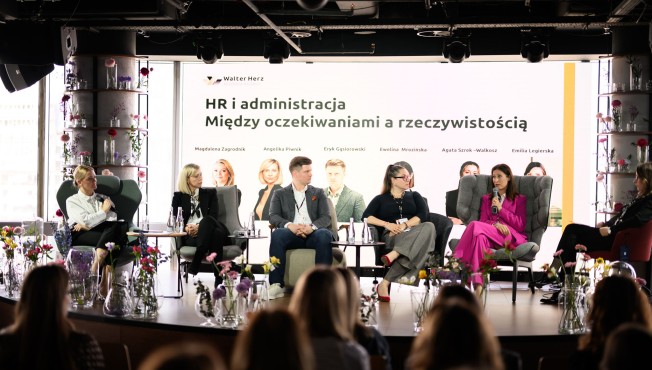
Office Decisions Through the Lens of Management, HR and Administration – Akademia Najemcy "One Office, Many Perspectives"
On 16 April, SkyHall at Warsaw's Spektrum Tower hosted another edition of the Walter Herz Akademia Najemcy, under the theme "One Office, Many Perspectives."

Contact us